Welcome to Early Years at Palace Fields
Welcome to Early Years at Palace Fields Primary School. Our Nursery and Reception provide a happy, nurturing and stimulating environment where children can feel safe, develop confidence and build a lifelong love of learning.
We recognise that every child is unique and aim to provide exciting, meaningful experiences that build upon children's interests, experiences and individual starting points.
Our Early Years Vision
At Palace Fields, we believe that every child deserves the very best start to their education. Our Early Years provision provides a happy, safe and nurturing environment where children feel valued, develop confidence and build a lifelong love of learning.
We have high expectations for every child and recognise that children develop in different ways and at different rates. Through high-quality interactions, carefully planned experiences and a stimulating learning environment, we support and challenge every child to make progress from their individual starting points.
From the very beginning of their journey at Palace Fields, children are encouraged to develop our school values of Kindness, Integrity and Tenacity. We help children to become increasingly independent, resilient and confident, while learning how to build positive relationships with others.
We recognise parents and carers as children's first and most important educators. By working closely together, sharing information and celebrating children's achievements, we can help every child to grow and flourish.
Our Early Years Environment:
Our learning environment is carefully organised so that children can access resources independently, follow their interests and revisit their learning throughout the day.
Children have access to both indoor and outdoor learning experiences, with opportunities for creative work, construction, reading, writing, mathematics, imaginative play, physical development and exploring the natural world.
Our Principles of Learning:
Our practice is guided by the four overarching principles of the Early Years Foundation Stage.
🌱 A Unique Child
Every child is unique. We recognise that children arrive in Early Years with their own experiences, interests, strengths and individual needs.
We see every child as a capable and confident learner and support them to become increasingly resilient, independent and self-assured. By getting to know each child well, we can build on what they already know and can do and provide appropriate support and challenge as they develop.
❤️ Positive Relationships
Children learn best when they feel safe, secure and valued.
We build warm, responsive and respectful relationships with our children so that they develop the confidence to explore, communicate, take risks and try new things.
Positive relationships with parents and carers are equally important. We value the knowledge families have about their children and work in partnership to support children's learning, development and wellbeing.
🏡 Enabling Environments
Our indoor and outdoor environments are carefully organised to encourage curiosity, independence, exploration and purposeful play.
Children have access to a wide range of open-ended resources and experiences which allow them to practise existing skills, follow their interests and develop new learning.
Adults observe children closely and use their knowledge of children's interests, development and next steps to adapt the environment and provide meaningful opportunities for learning.
💡 Learning and Development
Young children learn in many different ways. Throughout the day, children experience a balance of adult-led teaching, small-group learning, high-quality interactions and opportunities to explore and learn through play.
Children are encouraged to make choices, access resources independently, investigate their own ideas and return to their learning over time.
Learning takes place both indoors and outdoors, with both environments viewed as important spaces for children's learning and development.
What Does Learning Look Like in Early Years?
Learning in Early Years is active, meaningful and often playful.
Children might develop mathematical understanding while building with blocks, practise new vocabulary while sharing a story, explore scientific ideas outdoors, develop fine-motor skills through creative activities or learn how to negotiate and solve problems while playing with friends.
Alongside this, children take part in carefully planned adult-led teaching, including early reading and phonics, mathematics, communication and language, and other areas of our curriculum.
Our adults play an important role in children's learning. They observe, model language, ask questions, introduce new vocabulary, demonstrate skills and sensitively extend children's thinking and ideas.
The Importance of Play
Play is a fundamental part of learning and development in the Early Years.
Through purposeful play, children explore ideas, practise new skills, develop language, use their imagination, solve problems and learn how to cooperate with others.
Our learning environment is carefully planned so that children can revisit and apply the knowledge and skills they have been taught. Adults interact with children during their play to introduce new ideas, deepen thinking and move learning forward.
Characteristics of Effective Learning
As well as considering what children learn, we think carefully about how children learn.
The Characteristics of Effective Learning describe the behaviours children use as they explore, investigate and develop their ideas.
🔎 Playing and Exploring
Children investigate, experience new things, follow their interests and develop a willingness to have a go.
⭐ Active Learning
Children become involved in their learning, concentrate, persevere when things are difficult and experience the satisfaction of achieving what they set out to do.
💭 Creating and Thinking Critically
Children develop their own ideas, make connections between their experiences, solve problems and begin to think about different ways of doing things.
We support these characteristics throughout our provision to help children become curious, motivated and increasingly independent learners.
What Do Children Learn?
Children's learning and development is organised into seven interconnected areas of learning. All seven areas are important and are developed through a combination of direct teaching, meaningful experiences, high-quality interactions and play.
The three prime areas are particularly important in building the foundations for children's learning, relationships and development:
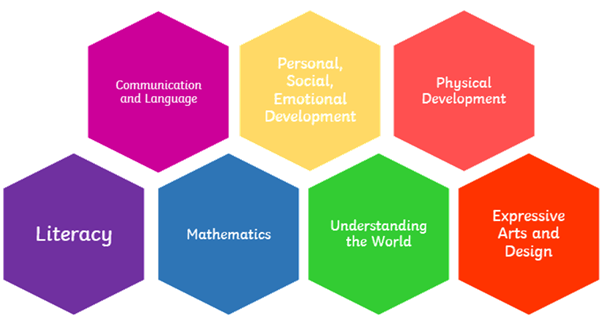
🗣 Communication and Language
Listening & attention • Understanding • Speaking
❤️ Personal, Social and Emotional Development
Self-regulation • Managing self • Building relationships
🏃 Physical Development
Gross motor skills • Fine motor skills • Heath and self-care
These are strengthened and applied through the four specific areas:
📚 Literacy
Comprehension • Word reading • Writing
🔢 Mathematics
Cardinality and Counting • Comparison • Composition • Pattern • Shape and Space • Measures
🌍 Understanding the World
Past and present • People, culture and communities • The natural world • Technology
🎨 Expressive Arts and Design
Creating with materials • Being imaginative and expressive
Children's learning does not happen in isolation. A single experience may support several areas of learning at the same time.
Working in Partnership with Families
Parents and carers know their children best, and we value the important role families play in children's learning and development.
We aim to build open and positive relationships with families from the beginning of their child's Early Years journey. We regularly share information about children's experiences and learning and encourage families to share children's interests, experiences and achievements from home.
Through working together, we can build a fuller picture of each child and provide consistency between home and school.
You can find further information about our Nursery and Reception classes and our Early Years curriculum using the links below:
Nursery and ReceptionEarly Years Curriculum
If you have any questions about Early Years at Palace Fields, please contact:
Mrs Ferguson, Early Years Class Teacher, through the school office on 01928 242855.